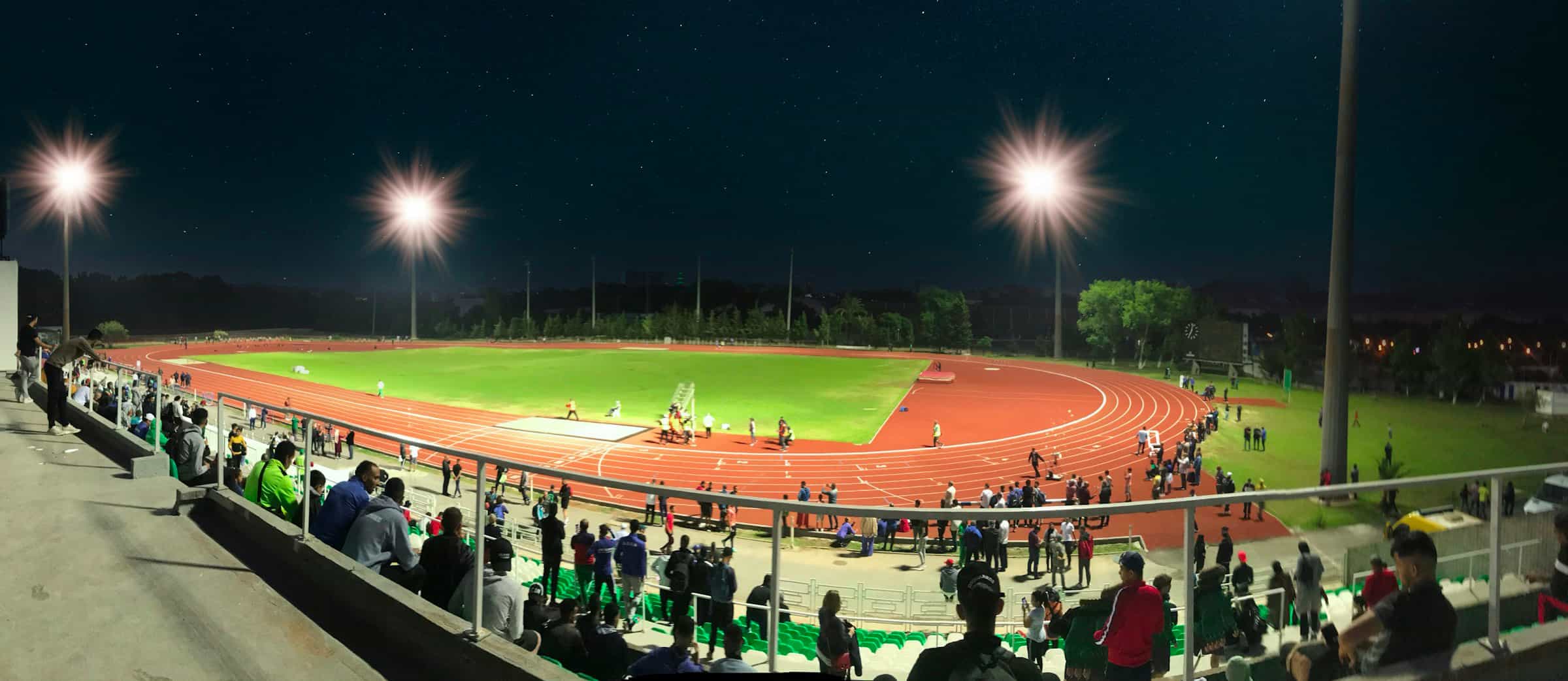
One day, one continuous clock
24-Hour Races
A fixed-time race where the clock runs for one full day and every completed lap or measured distance counts.
Cover photo: Amine Mouzaoui / Unsplash
Turn the Format Into a Race Plan
In a 24-hour race, the task is to cover as much distance as possible before the clock expires. Many events use short loops or tracks, so runners can return frequently to food, spare clothing, shoes, crew, and medical support.
The clock keeps running during walks, meals, clothing changes and rest. Your plan therefore needs both a sustainable moving pace and time for looking after yourself. An average pace calculated over 24 hours is not the pace you must hold while moving.
Use this page to assemble your race plan: complete the checklist, choose the guides for the gaps you find, then compare events. The separate rules explainer and calendar are linked below so you can check course details without losing your preparation sequence.
Build Your One-Page Race Plan
Copy these six decisions into your race notes. Replace assumptions with the organizer’s current rules and observations from your own training. The useful outcome is a plan your crew can follow and you can revise while tired.
| Decision | Write down | Check or rehearse |
|---|---|---|
| Course and timing | Measured lap length, surface, start/finish time and aid location. | Confirm partial-lap scoring, direction changes and any minimum result requirement. |
| Distance and time budget | A provisional distance, expected moving time and separate stop allowance. | Compare the required moving pace with rehearsed effort; include a slower scenario. |
| Run-walk routine | A time or landmark cue, tested paces and a point to review the plan. | Can you restart without surging, and keep the routine when it gets dark? |
| Food and aid stops | Familiar foods, where they are stored and what crew should hand over. | Rehearse access and tolerability; identify alternatives if the first choice stops working. |
| Feet, weather and lighting | Tested footwear, spare layers, lights and labelled kit locations. | Check forecast, battery duration and whether personal tables or shelters are permitted. |
| Rest, help and getting home | Rest options, medical location, emergency contact and return transport. | Agree how to stop or revise the goal; arrange transport that does not depend on driving while sleepy. |
Clock check, not a suggested first-race target: 100 km with 2 hours stopped leaves 22 moving hours. That requires 100 ÷ 22 = 4.55 km/h while moving, or 13:12 per km. With 4 hours stopped, it requires 5 km/h, or 12:00 per km. Compare both with your own rehearsals; the arithmetic alone does not establish that either is sustainable.
Use the pace calculator for your own figures and the crew instructions template to turn your decisions into a handover sheet.
Checked figures
Distances that define the format
These are the current IAU world records and one complete published field. They show the range of the format. They are not a first-race target.
| Measure | Figure |
|---|---|
| Men's IAU world record | 319.614 km, Aleksandr Sorokin, Verona, 17 September 2022 |
| Women's IAU world record | 278.621 km, Sarah Webster, Albi, 18 October 2025; ratified by the IAU in January 2026 |
| Those records as average speed | 13.3 km/h men, 11.6 km/h women, over the full 24 hours |
| One complete field | London 24-hour, 20–21 September 2025: median 164.4 km, middle 50% 136.7–183.2 km, 52 results |
The London figures include early withdrawals and describe that race only. A useful personal range still comes from recent training, the course, and how much time you expect to spend walking or stopped.
Sources: IAU records list; IAU records update, January 2026; Statistics report: London 2025 field.
Curated preparation path
Learn, Train, and Plan
1. Choose Your Race and Goal
Shortlist a course whose surface, support and entry requirements fit you. Write down its measured lap length, start time and crew rules before setting a flexible goal.
Compare 24-Hour Races
Compare countries, surfaces, loop lengths, support and entry context for upcoming editions.
Guide24-Hour Races Explained
Format, course types, scoring, first-race decisions, and safety considerations.
AnswerHow Far Can You Run in 24 Hours?
A practical way to think about distance without treating one target as universal.
Guide24-Hour vs 48-Hour vs 6-Day
Compare timed formats before choosing the duration that fits your experience.
2. Build and Rehearse Your Training
Choose a framework suited to training you already recover from. Identify a familiar session in which to test your walking pattern, food, footwear and stop routine, then review recovery before progressing.
Train for Your First 24-Hour Race
An adaptable framework for endurance, walking, night practice, and recovery.
AnswerChoose a Training Timeline
Compare published plan lengths with your current workload and the time available before race day.
ToolRun-Walk Calculator
Rehearse run-walk cycles and see what average speed each pattern holds for a full day.
ToolMultiday Pace Calculator
Explore average-speed, lap, break-time, and run-walk scenarios.
3. Write the Pace and Support Plan
Calculate at least two stopped-time scenarios, list what crew should do at each stop, and agree how to revise the distance goal after a delay. Use the worked 100-mile example to understand the arithmetic.
24-Hour Race Pacing Strategy
Build conservative effort and run-walk scenarios that can adapt as conditions change.
GuideRehearse Your Walking Strategy
Test time, lap or hill cues and see how stops and later slowing change the distance calculation.
GuideWhat to Eat During a 24-Hour Race
Practice a flexible fueling system with familiar foods and fallback options.
GuideCrew and Aid Station Strategy
Organize supplies and decisions so short stops do not become repeated delays.
4. Pack and Check the Whole Routine
Finish with a labelled checklist and a rehearsed kit layout. Check overnight lighting, weather layers, foot-care access, spare equipment and a safe plan for getting home after the race.
24-Hour Race Gear Checklist
A race-specific packing list for clothing, lighting, nutrition, crew, and foot care.
Gear guideShoe Rotation Strategy
Plan tested alternatives for wetness, swelling, pressure changes, and surface fatigue.
ToolCrew and Drop-Bag Planner
Decide what waits at each stop so lap transitions stay short and repeatable.
Curated race directory
Active and Upcoming 24-Hour Events
20 matching events as of Oct 20, 2026; event source reviews dated June 22, 2026 – October 20, 2026. 7 past editions remain in the directory archive.
International Ultramarathon Festival — Loutraki
Loutraki, Greece
The 21st International Ultramarathon Festival, an IAU Bronze Label track meeting at the Loutraki Municipal Stadium. Features 48-hour, 24-hour, and 12-hour races on a 400 m track, branded by the organizer as World Cup races.
View verified race details →The Endless Mile
Alabaster, Alabama, USA
A 72-hour, 48-hour, and 24-hour festival on a certified, paved, lighted 1.00203-mile loop at Veterans Park.
View verified race details →Weekend at Burney
Cassel, near Burney, California, USA
A relaxed 48-hour and 24-hour trail race on a loop of about 4.6 to 4.8 miles past Baum Lake near Burney, California, with about 370 ft of climbing per lap, plus a 12-hour race and a burro race on Saturday.
View verified race details →Día de los Muertos Endurance Run
South Beach State Park, Newport, Oregon, USA
A timed loop race at South Beach State Park in Newport, Oregon, with 48-, 24-, 12- and 6-hour races and team relays on a 3,856 m loop of mostly flat trail with some pavement, held beside a Día de los Muertos ofrenda.
View verified race details →Laufwochenende Brugg
Brugg, Aargau, Switzerland
A 48-hour race with 24-, 12- and 6-hour options on a lit, fully paved 934 m loop on the Aare island at Geissenschachen in Brugg, doubling as the Swiss 48-, 24- and 6-hour championships.
View verified race details →Běh na 24 hodin Plzeň
Plzeň, Czechia
A 24-hour race on the athletics track of Plzeň’s municipal stadium in Skvrňany, run alongside 12-hour, 100 km and marathon races, with times also taken at the marathon and 100-mile marks.
View verified race details →ISOPOL Super24
Veszprém, Hungary
A 24-hour race on a closed 400 m synthetic track in Veszprém, held with 12- and 6-hour races and doubling as the Hungarian 24-hour championship. It is part of the Central-European Ultra Series (CEUS).
View verified race details →Salt Creek 24
Port Angeles, Washington, USA
A scenic 24-hour endurance race at Salt Creek Recreation Area on the Olympic Peninsula, on a 1.4-mile loop of paved and unpaved surfaces. Also offers a 12-hour solo race, 24-hour relay teams and an hourly Last Runner Standing up Striped Peak.
View verified race details →Antarctic Ice Ultra
Ultima Basecamp, Queen Maud Land, Antarctica
A fly-in Antarctic ultra on a 4.2 km out-and-back snow course at Ultima Basecamp in Queen Maud Land, with 50 km to 100-mile races, a 24-hour race and a 24-hour limit.
View verified race details →Fat Ox Endurance Runs
Goodyear, Arizona, USA
A fixed-time festival on a certified 0.988178-mile concrete loop, headlined by the 48-hour race and 2026 USATF 24-Hour Championships.
View verified race details →Bislett 24-Hour Indoor Challenge
Bislett Stadium, Oslo, Norway
A 24-hour race on the 546.5 m indoor track under the stands of Bislett Stadium in Oslo, with an official 100-mile split, a lottery for 150 places and a 165-runner cap.
View verified race details →Soochow International Ultramarathon
Soochow University Waishuangxi Campus, Shilin District, Taipei, Taiwan
An invitational 24-hour race on the 400 m track of Soochow University’s Waishuangxi campus in Taipei, held since 1999 and certified six times as an IAU Gold Label race.
View verified race details →24 Hores d'Ultrafons en Pista Barcelona
Barcelona, Spain
A charity-focused 24-hour track race at Barcelona's Estadi Municipal Joan Serrahima, accompanied by 12- and 6-hour events.
View verified race details →Desert Solstice Track Invitational
Phoenix, Arizona, USA
An elite invitation-only 24-hour and 100-mile track race at Camelback High School. Limited to 25 runners with qualifying standards. Organized by Aravaipa Running.
View verified race details →Across the Years
Peoria, Arizona, USA
A New Year fixed-time festival on a 1.42-mile dirt and paved loop at Peoria Sports Complex, with a 6-day race, rolling-start 72- to 6-hour races and 100- and 200-mile options.
View verified race details →Spartanion Tel Aviv 24-Hour
Hayarkon Park, Tel Aviv, Israel
Israel's national 24-hour championship on a fast paved loop in Hayarkon Park, with qualifying standards for the headline race.
View verified race details →Jackalope Jam
Cat Spring, Texas, USA
A timed ultrarunning festival at 7IL Ranch, where runners repeat a flat two-mile out-and-back and can choose events lasting up to 100 hours.
View verified race details →Jackpot Ultras
Cornerstone Park, Henderson, Nevada, USA
Aravaipa’s timed-race festival at Cornerstone Park offers 48-hour and 24-hour races alongside shorter timed events and fixed distances.
View verified race details →NZ Ultramarathon Festival — 6 Day
Hagley Park, Christchurch, New Zealand
A fully catered six-day race on a flat 1.9464 km park loop, part of a ten-day Christchurch festival with 72-, 48-, and 24-hour options.
View verified race details →Taiping 24 Hour
Taiping, Perak, Malaysia
A fixed-time festival at Taiping Lake Gardens with 24-, 12-, 6-, and 3-hour challenges. Confirm the final endurance-course measurement with the organizer.
View verified race details →Dates, entry status, routes, and rules can change. Use each event page's official organizer links before registration or travel. Format preparation paths were reviewed October 7, 2026.
24-Hour FAQs
What should I confirm with a 24-hour race organizer?
Confirm the measured course, start time, partial-lap scoring, aid provision, crew access and rules for leaving or rejoining the course. Ask whether there is a minimum distance or other condition for an official result. Short loops can simplify access to support, but the details vary by event.
How do I check whether my 24-hour distance goal fits the clock?
Subtract expected stopped hours from 24, then divide the proposed distance by the hours left to find the required moving speed. For example, 100 km with two stopped hours requires 4.55 km/h while moving. Use training observations and a slower scenario to assess that goal; this calculation is not a first-race recommendation or a prediction.
Compare Related Formats
48-Hour Races
A two-day fixed-time race where sleep, recovery choices, and the second night become central parts of the plan.
Backyard Ultras
A last-person-standing format built around one 6.7056 km loop every hour, on the hour, until one runner completes a yard that nobody else finishes.
6-Day Races
A 144-hour fixed-time event where sustainable routines and recovery choices matter across nearly a full week.