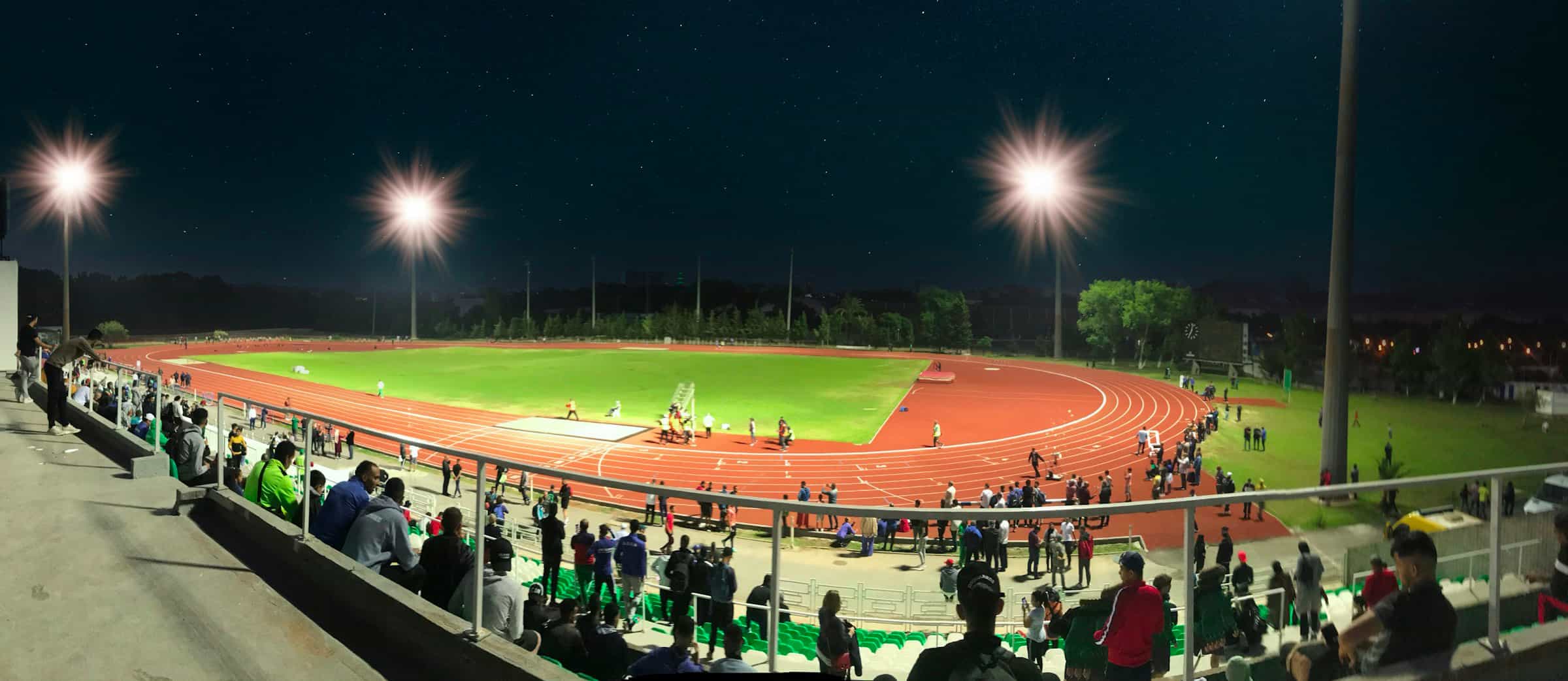
What Makes 24-Hour Training Different
A 24-hour event rewards sustainable movement and good decisions more than any single training pace. Preparation has to cover ordinary endurance fitness plus walking, fueling, foot care, temperature changes, equipment, and the ability to change the plan when something is not working. For the format, strategy, and calendar resources around this plan, start from the 24-hour race guide.
How Much Training You Need
The best study of recreational 24-hour runners found two things that predicted race distance: the longest training run before the race and marathon personal best. Weekly volume mattered less once those were known. Knechtle and colleagues followed 63 runners who averaged 146.1 km, and suggested that a long run of about 60 km and a marathon around 3:20 go with the best results. An earlier study of 15 male finishers of the 2007 Basel 24-hour run, who reported an average of 98.8 km of training a week.
From that, our recommendation is three tiers. Pick the one that matches your goal, not the most ambitious one.
| Tier | Race goal | Weekly volume | Longest run | Key sessions |
|---|---|---|---|---|
| Finish | 100–130 km | 50–70 km at peak | 30–40 km, or 4–5 hours | One back-to-back weekend (long run, then 1.5–2 hours the next day) |
| Target | 140–180 km | 70–100 km at peak | 50–60 km, or 6–8 hours | Back-to-backs every second weekend and one 6–8 hour timed rehearsal on a loop |
| Competitive | 200 km and beyond | 110–160 km at peak | 60–80 km, or a 100 km race 6–8 weeks out | Marathon-pace work for speed reserve plus a 12-hour rehearsal |
Check your goal against the study. The Knechtle equation is 234.7 + 0.481 × longest training run (km) − 0.594 × marathon best (minutes). A 4:00 marathoner whose longest run is 40 km gets about 111 km; a 3:30 marathoner with a 50 km long run gets about 134 km. It explained just under half the variation between runners, so treat it as a sanity check, not a forecast.
The 12-Week Plan
Twelve weeks is enough if you are already running 4–5 times a week. Volume rises through weeks 1–9 to your tier's peak, then falls for the taper. Repeat a week instead of progressing if you are not recovered.
| Phase | Example weeks | Purpose |
|---|---|---|
| Foundation check | 1–3 | Hold your current volume; add walk breaks, two strength sessions, and eating on every run over 90 minutes |
| Specific preparation | 4–7 | Add about 10% a week to volume and 30–45 minutes to the long run; first back-to-back weekend in week 6 |
| Consolidation | 8–9 | Peak weeks: your tier's longest run and, for the Target tier, the 6–8 hour timed rehearsal |
| Review and taper | 10–12 | Week 10: about 80% of peak volume. Week 11: about 60%. Race week: about 40%, with two short runs at race pace. |
A Worked Peak Week
This is a peak week (week 8 or 9) for the Finish tier: about 8.5 hours and 65–70 km of running and walking, plus two 20-minute strength sessions. Target-tier runners add an extra easy hour midweek and stretch Saturday to 6 hours.
| Day | Session | What to practice |
|---|---|---|
| Monday | Rest | Check recovery from the previous week; prepare familiar food and equipment. |
| Tuesday | 60 minutes easy (about 9 km) + 20 minutes strength | Relaxed effort; step-ups, split squats and calf raises. |
| Wednesday | 60 minutes run/walk, 25:5 (about 9 km) | Hold the walk at about 6 km/h; note how quickly you settle back into running. |
| Thursday | 60 minutes easy (about 9 km) + 20 minutes strength | Finish around dusk to check lights, then keep your normal bedtime. |
| Friday | Rest | Pack the same bottles, socks, and food you intend to use at the race. |
| Saturday | 4 hours run/walk, 25:5 (about 30 km) | Eat 50 g carbohydrate an hour, change socks once, and log moving and stopped time separately. |
| Sunday | 90 minutes run/walk on tired legs (about 12 km) | The back-to-back: same food, same shoes. Cut it to 45 minutes if anything hurts. |
Getting there: reach this week by adding about 10% a week from where you start. Do not lengthen the long run and add the back-to-back day in the same week.
A completed rehearsal review
Example log: planned 4 hours; completed 3 hours 48 minutes moving and 12 minutes stopped. The food stayed down; finding spare socks took four minutes. Next session: label the sock bag and aim for under 8 minutes stopped. Saving 10 minutes every 4 hours adds up to an hour over 24 hours, worth about 5 km at first-timer pace.
For race arithmetic, 120 km in 24 hours with two hours stopped means 22 moving hours: 11:00 per km moving pace, versus 12:00 per km across the full clock. This is a calculation, not a prediction. Compare your own assumptions in the pace calculator and run/walk calculator, then record stops in the crew planner.
Why build volume at all: the Burgess study followed 106 runners tracked across 14 weeks around the 2018 Comrades Marathon, in which lower pre-race training loads were associated with higher injury risk. Undertraining, not only overtraining, raised injury risk.
Weekly Decision Rules
A good week has 4–5 runs, one long run, two short strength sessions, and at least one full rest day. Keep 80% or more of running easy enough to talk. Change one thing at a time: duration, frequency, elevation or intensity.
- Progress after recovery: repeat the same load or take a lighter week if soreness, sleep, mood, or easy pace has not returned to normal.
- Protect easy days: race-specific practice should not turn every session into a depletion test.
- Keep recovery visible: schedule rest, adequate food, and sleep as part of the plan rather than as rewards for completing it.
- Individualize with help: a qualified coach can translate these principles into training that reflects your background and event.
Progress Time on Feet
Add 30–45 minutes to the long run every one or two weeks until you reach your tier: 4–5 hours for Finish, 6–8 hours for Target. Run the long run as run/walk from the start, eat on schedule, and stop for one sock change, so each one rehearses the race.
Long-session duration is not a badge of readiness. Stop adding time when form deteriorates, a focal pain changes your gait, nutrition is no longer staying down, or the session creates fatigue that disrupts the following training cycle. A shorter repeatable session is more useful than an extreme outing that requires prolonged recovery.
Back-to-Back Sessions
A back-to-back is a long run followed the next day by a shorter one, typically 40–50% of Saturday's duration. It teaches you to run on tired legs without the recovery cost of one very long day. Finish-tier runners need one; Target-tier runners do one every second weekend from week 6.
Add this pattern only after single long sessions are stable. Remove it if pain, sleep disruption, unusual fatigue, or declining performance carries into the next week. Runners with recurrent injury may be better served by walking, cycling, or another lower-impact option selected with a clinician or coach.
Walk Training
Walking is how most runners finish 24 hours, not a sign the race has gone wrong. Our default is 25 minutes running and 5 minutes walking from the first hour, at a brisk 6 km/h (10:00 per km) walk. At 25:5 you walk for about 4 of the 24 hours, so walking at 6 km/h instead of 5 km/h is worth about 4 km.
- Compare short planned breaks with walking only when effort rises.
- Practice smooth transitions without sprinting to make up time.
- Use the actual course gradient when deciding where walking may help.
- Test poles only if the event permits them and you already know how to use them safely.
Night-Equipment Practice Without Sleep Loss
Darkness changes visibility, footing, temperature, and equipment needs. Test those variables after sunset on a safe, familiar route with suitable support. End the session in time to protect normal sleep; there is no need to rehearse a 24-hour race by deliberately staying awake.
Check your primary and backup lights, reflective details, warm layers, battery changes, and the ease of eating while wearing night gear. If you plan to use caffeine, test the race dose in a late-afternoon long run: about 50 mg an hour, or 1–2 mg per kg every two hours, as set out in the 24-hour nutrition guide.
Strength and Recovery
If strength training is already part of your routine, retain one or two manageable sessions built around sound technique. Step-ups, split squats, calf raises, hip-hinge movements, and trunk exercises are possible options, not a compulsory checklist. Start with professional instruction if these movements are unfamiliar or provoke symptoms.
Adequate energy intake matters as training grows. Persistent fatigue, recurrent illness, declining performance, mood changes, reproductive changes, or repeated bone and tendon problems can be signs that load and recovery are out of balance. Do not answer those signs by adding more training.
Prepare Decisions, Not Suffering
Mood and attention can fluctuate during a long event, and reasons for non-completion are multifactorial. Prepare simple responses for ordinary problems while keeping medical stop rules separate from motivational strategies.
- If effort drifts up, slow down or walk and reassess the pacing plan.
- If food becomes unappealing, use a previously tested alternative rather than an improvised product.
- If a hot spot develops, address it early instead of waiting for a blister.
- If low mood arrives, narrow the task to the next routine check and ask crew for help.
- If confusion, fainting, chest pain, severe breathlessness, or loss of coordination occurs, stop and seek medical help.
Taper and Race Week
Taper for two weeks. The Wang meta-analysis of endurance athletes found the best results with tapers of up to 21 days that cut volume by 41–60% while keeping intensity and session frequency unchanged. In practice: about 60% of peak volume in the second-to-last week and about 40% in race week, with two short runs at race pace.
Keep movement familiar, remove demanding race simulations, prioritize sleep and adequate eating, and avoid making up missed training. If you are still unusually fatigued or symptomatic near race day, a coach or sports clinician can help decide whether starting is appropriate.
Stop and Adjust Criteria
Pause progression and seek qualified assessment for pain that changes your gait, focal pain that persists or worsens, recurrent illness, unexplained performance decline, or fatigue that does not improve with rest. Stop immediately and seek urgent care for chest pain, fainting, confusion, severe breathing difficulty, or other acute concerning symptoms.
- Avoid copying volume: another runner's week says nothing about what you can currently absorb.
- Avoid rehearsing exhaustion: test systems without recreating race-day damage or sleep loss.
- Avoid stacking changes: alter one training demand at a time.
- Avoid under-fueling the build: increasing load while restricting intake can impair health and performance.
- Avoid treating the start line as mandatory: unresolved symptoms are a reason to reassess, not a test of commitment.
Sources
- Knechtle, B. et al. (2011). Personal best marathon time and longest training run, not anthropometry, predict performance in recreational 24-hour ultrarunners. Journal of Strength and Conditioning Research, 25(8), 2212–2218.
- Knechtle, B. et al. (2009). Personal best marathon performance is associated with performance in a 24-h run and not anthropometry or training volume. British Journal of Sports Medicine, 43(11), 836–839.
- Burgess, T.L. et al. (2025). Assessing the relationship between training load and injury in ultramarathon runners: a novel approach using Generalised Additive Models. South African Journal of Sports Medicine, 37(1), v37i1a20747.
- Schwellnus, M. et al. (2016). IOC consensus statement on load in sport and risk of illness. British Journal of Sports Medicine.
- Mountjoy, M. et al. (2023). IOC consensus statement on Relative Energy Deficiency in Sport. British Journal of Sports Medicine.
- Kishi, A. et al. (2024). Sleep and Ultramarathon: Exploring Patterns, Strategies, and Repercussions of 1,154 Mountain Ultramarathons Finishers. Sports Medicine - Open, 10(1), 34.
- Wang, Z. et al. (2023). Tapering in endurance athletes: systematic review and meta-analysis. PLOS ONE.
Frequently Asked Questions
How many miles per week should I run for a 24-hour race?
Our recommendation: 50–70 km a week at peak to finish 100–130 km, 70–100 km a week to target 140–180 km, and 110–160 km a week for 200 km and beyond. The longest training run matters more than the weekly total: in a study of 63 recreational 24-hour runners it was, with marathon best, the strongest predictor of race distance.
Can I train for a 24-hour race if I have only run a marathon?
Yes. A marathon finish plus 12 weeks of consistent training is enough to aim for 100 km, which needs only a 4.2 km/h average. Build to the Finish tier: 50–70 km a week, a 30–40 km long run and one back-to-back weekend. If you are coming back from injury, add 4–8 weeks of base first.
How important is walk training for a 24-hour race?
Very: expect to walk for several hours of the race. Practice a brisk walk of about 6 km/h (10:00 per km) and use our default pattern of 25 minutes running and 5 minutes walking from the first hour, in every long run.
Should I do a practice night run before a 24-hour race?
Test your light, layers, visibility, and footing after dark, preferably with a partner or on a safe familiar route. You do not need to skip sleep or set a middle-of-the-night alarm; deliberate sleep deprivation can impair performance and safety.
What distance should I target in my first 24-hour race?
Our recommendation for a first 24-hour race is 100 km if you have finished a marathon or 50K, and 130–160 km if you already have a 100-mile finish behind you. Set the goal, a stretch 20 km above it, and finishing healthy as the floor.