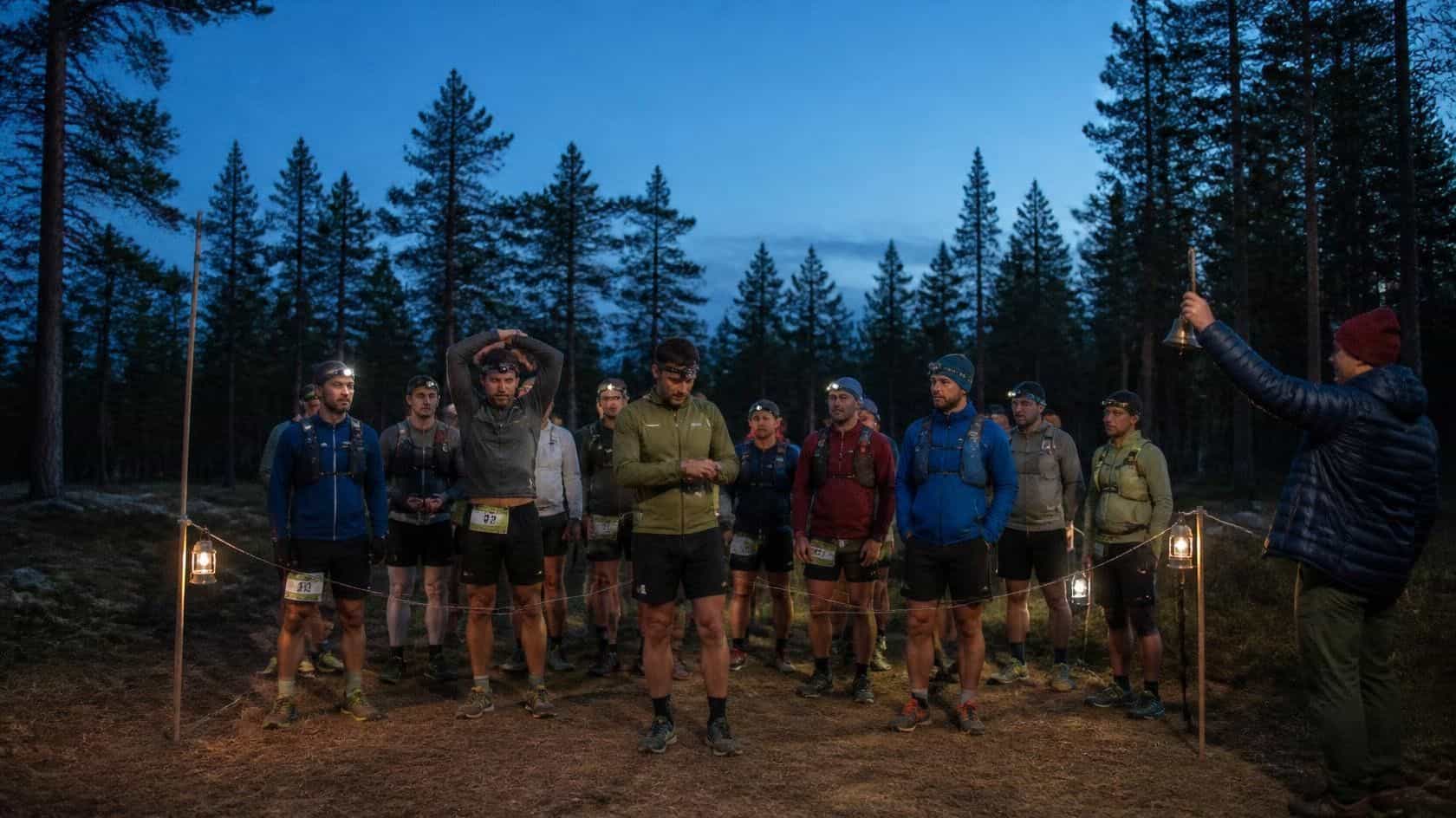
A backyard ultra is an open-ended ultrarunning format: there is no announced finishing distance, and the field starts another loop every hour until one runner completes a yard that nobody else finishes. That simple rule creates a distinct pacing, recovery, and decision-making challenge. This explainer covers the rules and records; the backyard ultra guide collects training, strategy, nutrition, and the event calendar in one place.
What Is a Backyard Ultra?
Every hour, all remaining runners start a yard of 4⅙ miles (6.7056 km). A runner must finish in less than an hour and start again at the next bell to remain in the race. The winner completes one more yard than every other runner. All other participants are recorded as DNF with their completed-yard totals retained.
For example, two runners start yard 30. One finishes and the other does not: the runner with 30 completed yards wins over 29. No yard 31 is required. If both finish 29 but neither completes yard 30, there is no winner. The deciding yard does not have to start solo.
The Rules
The official Big's Backyard Ultra organization maintains the championship pathway and event directory. Confirm each organizer's published rules and course measurement; the core format is:
- One loop per hour: Each standard yard is four miles and 880 feet (6.7056 km). Confirm the course measurement with the organizer.
- Start on the hour: All remaining runners must be in the starting corral when the next hour begins. If you are not there, you are out.
- Complete the loop: You must finish each loop within the 60-minute window. Running a 55-minute loop gives you 5 minutes of rest. Running a 45-minute loop gives you 15.
- Last person standing: The winner must complete one more yard than everyone else, even if another runner started that same yard.
- No winner is possible: If the last remaining runners all fail to start or complete the same loop, none of them win. Everyone gets a DNF.
Read the official backyard rules for corral, aid, equipment, and finish requirements.
The Math Behind the Distance
The exact standard distance is 100/24 miles per yard. The familiar 4.167-mile and 6.706-km figures are rounded; use the exact fraction for milestone calculations. Twenty-four yards equal 100 miles (160.9344 km):
- 12 loops = 50 miles (80.5 km) — half a day of running
- 24 loops = 100 miles (160.9 km) — a full day, the traditional ultramarathon benchmark
- 48 loops = 200 miles (321.9 km) — two full days
- 72 loops = 300 miles (482.8 km) — three full days
This means every participant can instantly calculate their total distance at any point in the race. It also means that reaching 24 loops — the first full day — is a powerful psychological milestone that many first-timers target.
History and Origin
The backyard ultra was invented in 2011 by Gary "Lazarus Lake" Cantrell — the same race director behind the infamous Barkley Marathons. The original event, Big's Backyard Ultra, takes place on Cantrell's property in Bell Buckle, Tennessee.
Cantrell designed the format as a thought experiment: what happens when you remove the finish line entirely? In a traditional ultra, you know the distance — 100 miles, 200 miles, 6 days. You can pace toward a goal. In a backyard ultra, the distance is determined by the field. You do not know how far you will need to run. You only know that you need to run farther than everyone else.
The entry concept is easy to understand, but repeated hourly loops can become physically and cognitively demanding. Sleep opportunities may be short, and the open-ended format adds uncertainty that fixed-distance races do not share.
Global Growth
From a single event in Tennessee in 2011, the format has spread worldwide. On October 3, 2026, the official national-record table listed runners from 121 nationalities:
- 95 of those nationalities have a national record of at least 24 yards (100 miles)
- 45 have a record of at least 48 yards (200 miles), and 11 of at least 100 yards (416.7 miles)
- Event status and qualifying rules change from year to year, so verify them on the official event page
- Courses range from roads and parks to trails, with different terrain, weather, lighting, crew, and medical arrangements
- A listing is not a safety endorsement; read the organizer's rules, cancellation terms, and support details before registering
A small loop can make logistics more compact than a point-to-point event, but it does not remove the need for accurate course information, weather planning, lighting, food and fluid access, and appropriate medical support.
World Championships
The backyard ultra world championship follows a two-year alternating cycle:
- Odd years — Individual World Championship:Held at Big's Backyard Ultra in Bell Buckle, Tennessee. Qualified athletes compete head-to-head until one remains.
- Even years — World Team Championship: A satellite format where dozens of countries simultaneously host a national backyard ultra on home soil. Each country fields a team of 15 runners. One point is awarded for every loop completed by each team member. The country with the highest total loop count wins.
As checked September 14, 2026, the official 2026 World Team Championship page lists a start of Saturday, October 17, 2026. Recheck the official site before travel because schedules and qualification details can change.
2025 Individual World Championship Results
- Overall winner: Phil Gore (Australia) — 114 laps (475 miles / 764.44 km)
- Runner-up: Ivo Steyaert (Belgium) — 113 laps
- Joint 3rd: Harvey Lewis (USA) and Jon Noll (USA) — 111 laps each
- Leading woman (DNF):Sarah Perry (Great Britain) — 95 laps (395.8 miles / 637 km), setting a new women's world record
Current World Records
Records are time-sensitive. The figures below were checked against the official national-record table on September 14, 2026:
- Men's World Record: 119 yards (495.8 miles / 797.97 km) — Phil Gore (Australia), Dead Cow Gully Backyard Ultra near Nanango, Queensland, finishing on June 26, 2025. That is nearly 5 continuous days of hourly running.
- Women's World Record:95 yards (395.8 miles / 637.03 km) — Sarah Perry (Great Britain), set at the 2025 Individual World Championship at Big's Backyard Ultra, Bell Buckle, Tennessee, in October 2025. Longer performances have been reported at other events since and not ratified, so use the official table rather than a results aggregator.
To put 119 yards in perspective: Phil Gore ran 4.167 miles every hour for nearly 5 days straight — a total of almost 800 km. That required managing sleep, nutrition, foot care, and mental state across roughly 120 consecutive hourly cycles.
Every step of the record since 2011, the women's progression and the national records are in our backyard ultra world record guide. The race where Gore set it has its own page: Dead Cow Gully Backyard Ultra.
What Makes It Different
The backyard ultra differs from fixed-distance and fixed-time formats in several important ways:
- No target distance: In a 24-hour race, you know you will run for 24 hours. In a 100-mile race, you know the distance. In a backyard ultra, you do not know how far you will need to go. The distance is determined entirely by the field.
- Stop-start rhythm: Unlike continuous running events, backyard ultras force a repeated cycle of effort and rest. Each loop ends with a brief window for eating, changing, and recovering before the next hourly start. This rhythm changes how fatigue accumulates and how nutrition must be managed.
- Psychological open-endedness:The mental challenge is unique. You cannot count down to a finish. Every completed loop simply earns you the right to start another one. Motivation must come from something deeper than "almost there."
- The social dynamic: You run with competitors who gradually drop away. The field shrinks around you. In the final hours, you may be running with only one or two other people, knowing that their decision to stop is the only thing that can end your race. This can create an intense psychological interplay.
The Psychology
Early research offers useful signals, but the relevant studies are small or use other ultra formats and should not be treated as universal backyard-ultra rules:
- Cognitive changes: A 2024 backyard-ultra study found slower reaction time and poorer Stroop-task performance after withdrawal. Its final analysis included 11 men, and one decision task did not show a significant change, so the result should not be generalized to every runner or cognitive skill.
- Pre-race sleep may matter:In that small study, better self-reported sleep during the prior week correlated with smaller changes in reaction-time measures. This is an association, not proof that a fixed "sleep banking" protocol prevents impairment.
- Boredom can be relevant: In one 24-hour race study, higher reported boredom was associated with reporting an action crisis (odds ratio 12.5 in that sample). The study was not a backyard ultra, did not establish boredom as a cause of quitting, and does not prove that an entertainment tactic improves results.
The practical takeaway is modest: protect sleep before the event, expect decision-making to become harder, use a written crew checklist, and plan event-permitted ways to manage monotony.
A Typical Backyard Ultra
A typical arc for a first-timer aiming for 12–24 yards:
- Earlier loops: Effort may feel controlled and the field may be social. Use a rehearsed pace instead of matching other runners.
- First night: Temperature, visibility, food tolerance, and alertness may change. Our default is no sleep on the first night; from the second, 5–10 minute naps in the gap between yards.
- Beyond one day: Fatigue, foot or stomach problems, and sleepiness may accumulate at different rates. Reassess symptoms instead of assuming they are normal for the loop count.
- Longer attempts: Sleep loss can impair performance and cognition. Re-read the stop-and-get-help list before each night, and apply it rather than debating it at 4 a.m.
Choosing Your First Backyard Ultra
If the format appeals to you, here is what to look for in your first event:
- Rules and affiliation: Check the official event listing, measured yard distance, and published local rules. Affiliation is not an independent safety certification; ask about aid, medical access, withdrawal, and transport arrangements separately.
- Crew-friendly: Look for events that allow personal support crews. Having someone manage your nutrition, gear, and morale between loops can reduce decision load, especially in your first race.
- Moderate terrain: Some backyard ultras run on flat park paths, others on hilly trails. For your first race, flat or gently rolling terrain lets you focus on learning the format rather than fighting the course.
- Event culture: Ask previous participants about briefings, accessibility, crew space, aid, medical support, and how organizers communicate during difficult conditions.
- Use a flexible target: A distance goal can guide planning, but it must never override medical red flags, unsafe conditions, or your decision to stop.
Sources
- Big's Backyard Ultra — Official event directory and championship information
- Big's Backyard Ultra — Official national-record table
- Big's Backyard Ultra — 2026 World Team Championship roster and event date
- Big's Backyard Ultra — 2027 Individual World Championship qualification roster
- Deutsche Ultramarathon-Vereinigung — Global ultramarathon results database
- Benchetrit, S. et al. (2024) — Sleep deprivation, extreme exertion, and cognitive performance at a backyard ultra. PLOS ONE.
- Weich, C. et al. (2022) — Does boredom matter for ultra-endurance athletes' crises? International Journal of Environmental Research and Public Health.
- Walsh, N.P. et al. (2021) — Sleep and the athlete: expert consensus recommendations. British Journal of Sports Medicine.
Frequently Asked Questions
What is a backyard ultra?
A backyard ultra is a last-person-standing endurance race. Every hour, runners must start and complete a loop of 4 miles 880 feet (6.7056 km), commonly rounded to 4.167 miles. If you fail to start or finish a loop in time, you're eliminated. The winner completes one more yard than everyone else. If no runner can do that, there is no winner.
How far is a backyard ultra loop?
Each standard loop is 4⅙ miles (6.7056 km), usually rounded to 4.167 miles or 6.706 km. Twenty-four standard loops equal 100 miles. 12 loops = 50 miles, 48 loops = 200 miles, 72 loops = 300 miles.
What is the backyard ultra world record?
The overall record is 119 yards (495.8 miles / 797.97 km) by Phil Gore of Australia, set at Dead Cow Gully near Nanango, Queensland, in June 2025. The women's record is 95 yards (395.8 miles / 637.03 km) by Sarah Perry of Great Britain, set at Big's Backyard Ultra in Bell Buckle, Tennessee, in October 2025. Checked against the official record table on September 14, 2026; later claims from other events have been set aside by the organizers, so confirm on the official table.
Who invented the backyard ultra?
The backyard ultra was invented in 2011 by Gary 'Lazarus Lake' Cantrell, the creator of the Barkley Marathons. The original event, Big's Backyard Ultra, takes place in Bell Buckle, Tennessee.
Where are backyard ultras held?
Worldwide. On October 3, 2026, the official Big's Backyard national-record table listed runners from 121 nationalities, 95 of them with a national record of at least 24 yards (100 miles). Check the official directory and the organizer's own page for current dates before making travel plans.