A 24-hour race is a common entry point into timed ultrarunning. The core concept is simple: cover as much distance as possible between the start and the 24-hour signal. Course, support, stopping, and partial-lap rules still vary by event, so read the race manual rather than assuming every timed race works identically. This explainer covers how the format works; the 24-hour race guide collects training, pacing, nutrition, gear, and the event calendar in one place.
How a 24-Hour Race Works
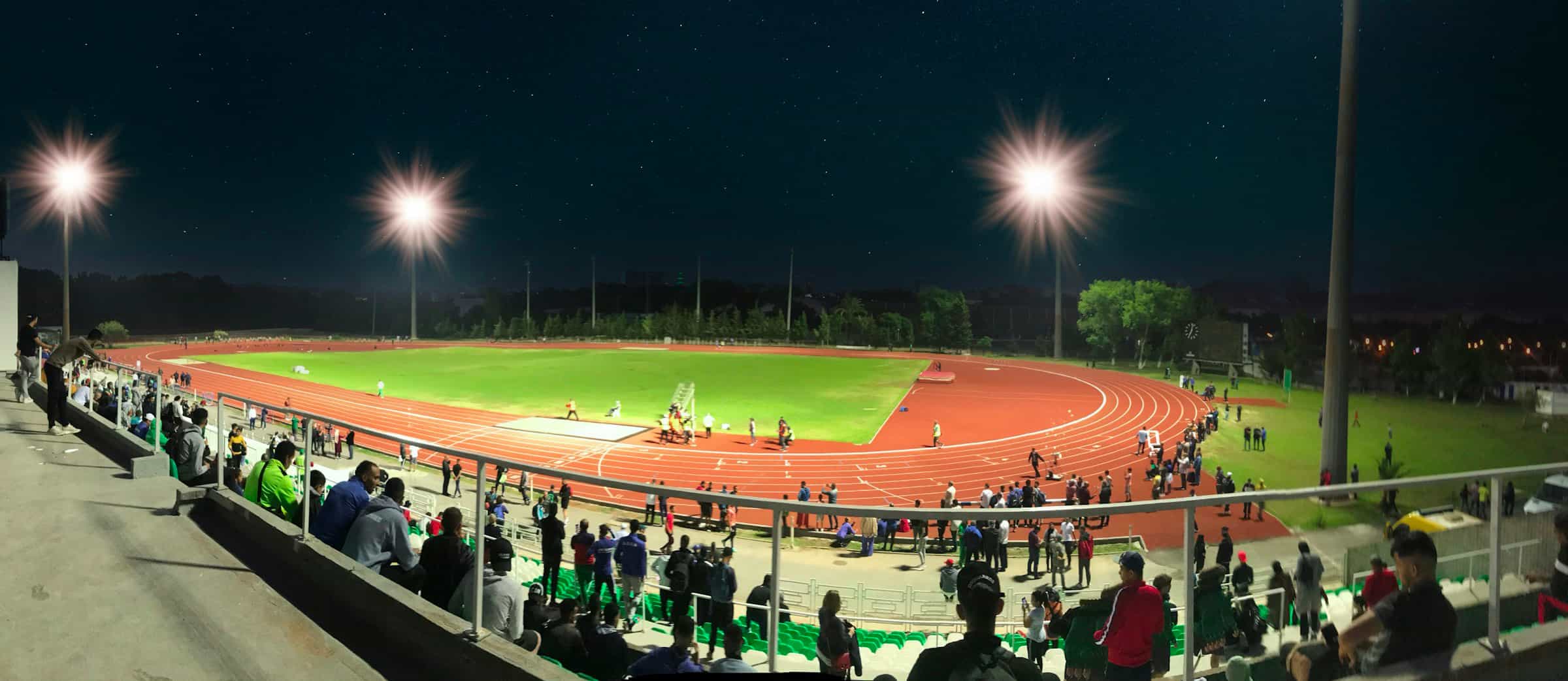
Most 24-hour races take place on flat, looped courses. Common formats include:
- Track events — 400m running tracks, usually at schools or athletic clubs
- Short road loops — 1–2 km paved loops in parks or around athletic facilities
- Longer loops — 5–10 km loops that offer more visual variety but less frequent crew access
Each loop is counted, usually by electronic timing or manual lap counters, and total credited distance at the 24-hour signal determines the result. Some events measure a final partial lap; others count only completed laps. The race rules control.
Races typically provide a central aid station with water, electrolytes, basic food (fruit, sandwiches, soup, cookies), and medical support. Most also designate a personal support area where you or your crew can set up a tent, chair, cooler, and gear changes.
A result-accounting example
On a hypothetical measured 1 km loop, 120 complete laps give 120 km. If the rules credit a measured 350 metres of the final lap, the result is 120.350 km; if only full laps count, it remains 120 km. Walking and stopping use race time without changing the lap length. Confirm when and where you may leave and re-enter the course.
Compare actual courses in the 24-hour race calendar, then use the pace calculator to separate moving pace from time at aid or rest.
How a First 24 Hours Splits
Here is how a 100 km first race usually splits, for a runner starting at noon. Your hours will differ, but plan the quarters roughly like this:
- Hours 0–6, about 32 km: run/walk at 25 minutes to 5 from the first lap, even though it feels too easy. Eat about 50 g of carbohydrate an hour from the first hour.
- Hours 6–12, about 25 km: feet, stomach and motivation start to change. Do the night changeover before dark: lights, warm layers, fresh socks.
- Hours 12–18, about 22 km: the night. Mostly walking at 5–6 km/h, warm savory food, and about 50 mg of caffeine an hour. Sleepiness peaks before dawn.
- Hours 18–24, about 21 km: daylight helps mood but not legs. Keep eating, keep the walk brisk, and stop for warning signs even if 100 km is close.
Who Runs 24-Hour Races?
An analysis of 210,455 results from 12- and 24-hour races found the fastest average age interval was 41–50, while mean podium ages were approximately 41–44 — about two to three years younger than the overall field average of 44–46. That is a population description, not a rule that every runner peaks in that decade. Fitness, health, participation history, pacing, nutrition, and race conditions all matter.
At the very top of the sport the 24-hour gap between men and women is about 13%: Sarah Webster's 278.621 km world record is 87% of Aleksandr Sorokin's 319.614 km. Studies of 100 km racing give different figures depending on what they compare: 5.0% between the fastest-ever performances, and 14.9% ± 4.2% among top-ten finishers in selected races. Women sometimes win 24-hour races outright.
What to Expect Physically
A 24-hour race places substantial stress on the body. Common patterns can help you prepare, but they should not be used to dismiss every symptom as normal:
- Muscles: Soreness, reduced strength, and rises in muscle-damage markers such as creatine kinase can occur. The range is wide; severe or worsening pain, profound weakness, marked swelling, or tea-colored urine needs urgent assessment.
- Feet: Pressure points, hot spots, blisters, and swelling may develop. The amount and timing are individual, so use tested lacing or footwear options in response to actual fit rather than assuming a one- or two-size increase.
- Energy balance: Expenditure commonly exceeds intake, but the gap varies with distance, body size, pace, food tolerance, and conditions. Body-mass change is also affected by fuel use, glycogen- associated water, food in the gut, and swelling; it is not a simple hydration diagnosis.
- GI symptoms: Nausea, bloating, appetite loss, diarrhea, or vomiting may occur. Intensity, heat, mechanical jostling, food, and fluid strategy can all contribute. Repeated vomiting, severe pain, blood, or inability to keep fluid down requires medical help.
- Cardiac and kidney changes: Biomarkers and measures of function can change after prolonged exercise and often improve during recovery. A fixed two- or three-day timeline cannot be promised, and chest pain, fainting, unusual breathlessness, very low urine output, or persistent swelling needs clinical assessment.
The Dark Hours
If you start a 24-hour race in the morning, the period from roughly midnight to 5 AM can be a low point. The combination of accumulated fatigue, circadian rhythm disruption, and cold is powerful.
Sleep deprivation and prolonged effort can impair attention, reaction time, judgment, mood, and coordination, although the size of the effect differs by runner. Decide rest, pacing, crew check-ins, and stopping rules in advance rather than relying entirely on sleep-deprived judgment.
Useful options may include a tested caffeine plan, adequate lighting, walking with another runner where race rules allow, and structured crew check-ins. Caffeine is not a treatment for confusion, loss of coordination, involuntary sleep episodes, or other warning signs; stop and seek help.
Crew and Support
Most 24-hour races allow personal crews — friends or family who manage your nutrition, gear, and morale from a base area near the course. Having a crew is not required, but it can reduce decision load:
- They prepare food so you do not have to think about it
- They help identify fit changes or hot spots and involve foot-care support early
- They help you reassess and follow your practiced nutrition range without forcing intake
- They provide emotional support during the low points
- They support your choices, note concerning changes, and help involve race or medical staff when needed
If you do not have a crew, you can still succeed. Many solo runners prepare labeled bags for each 3-hour block, pre-pack nutrition, and rely on the race aid station.
Realistic Goals for First-Timers
Setting realistic expectations is one of the most important things you can do for your first 24-hour race:
- Start from the site target: Our recommendation for a first 24-hour race is 100 km if you have finished a marathon or 50K, and 130–160 km if you already have a 100-mile finish behind you. For comparison, the median at the 2025 London 24-hour, an experienced field, was 164.4 km. See how far you can run in 24 hours for the arithmetic.
- Check the actual course: Surface, loop length, weather, elevation, congestion, and support access can materially change the distance covered
- A/B/C goal framework: Set a performance range, a process goal, and a safety goal. The final goal can be making sound decisions and stopping when symptoms, conditions, or event staff make continued participation inappropriate
A fast start costs more later than it gains early. For a 100 km goal, the overall average is 4.2 km/h including stops; run the first hours no faster than you could hold at hour 18, and walk 5 minutes in every 30 from the start.
Choosing Your First Race
Look for these features when selecting your first 24-hour event:
- A course and surface you have prepared for
- Clearly documented crew and personal-aid rules
- Published aid, overnight, medical, withdrawal, and transport arrangements
- Clear first-timer information and responsive organizers
- Weather and climate demands you can plan for
- Timing and results procedures explained in the race rules
Sources
- International Association of Ultrarunners — 24-hour championship information and records
- Deutsche Ultramarathon-Vereinigung — Ultramarathon statistics database
- Knechtle, B. & Nikolaidis, P.T. (2018) — "Physiology and Pathophysiology in Ultra-Marathon Running." Frontiers in Physiology, 9, 634.
- Hohl, R. et al. (2019) — "Blood Cardiac Biomarkers Responses Are Associated with 24 h Ultramarathon Performance." Heliyon, 5(6), e01913.
- Hew-Butler, T. et al. (2015) — Statement of the Third International Exercise-Associated Hyponatremia Consensus Development Conference. Clinical Journal of Sport Medicine, 25(4), 303–320.
- Wu, S. et al. (2023) — "Electrophysiological Mechanism of Attention of Sleep Deprivation: Evidence From Event-Related Potentials Data." Cureus, 15(1), e33464.
- Thuany, M. et al. (2022) — Trends in Participation, Sex Differences and Age of Peak Performance in Time-Limited Ultramarathon Events: A Secular Analysis. Medicina, 58(3), 366.
- Zingg, M.A. et al. (2014) — Will women outrun men in ultra-marathon road races from 50 km to 1,000 km?. SpringerPlus, 3, 97.
- Senefeld, J. et al. (2016) — "Sex Differences in Participation, Performance, and Age of Ultramarathon Runners." International Journal of Sports Physiology and Performance, 11(7), 635–642.
Frequently Asked Questions
How does a 24-hour race work?
You cover as much distance as possible before 24 hours expires, commonly on a track or short road or trail loop. The event rules explain timing, complete laps, any partial-lap measurement, support areas, and when runners may leave or re-enter the course.
How are partial laps counted at the end of a 24-hour race?
At the final signal you stop where you are and a marshal marks your position; the distance from the last timing point is measured and added to your completed laps. Many loop races do this, and IAU-style championships require it. Some smaller events count completed laps only, so check the rules before planning a last-lap sprint.
Can you leave the course during a 24-hour race?
Usually yes. You can stop at your table, use the toilet, change clothes or lie down, then rejoin where you left; the clock keeps running. Most races ask you to cross the timing mat or tell the lap counters when you leave and return. A few forbid leaving the course area at all.
What happens to your body during a 24-hour race?
Responses vary. Muscle soreness and strength loss are expected; gastrointestinal symptoms, foot swelling or pressure changes, sleep-related attention impairment, and changes in cardiac, kidney, inflammatory, and other laboratory markers may occur. Chest pain, confusion, collapse, repeated vomiting, very dark urine, or severe worsening pain requires medical assessment.