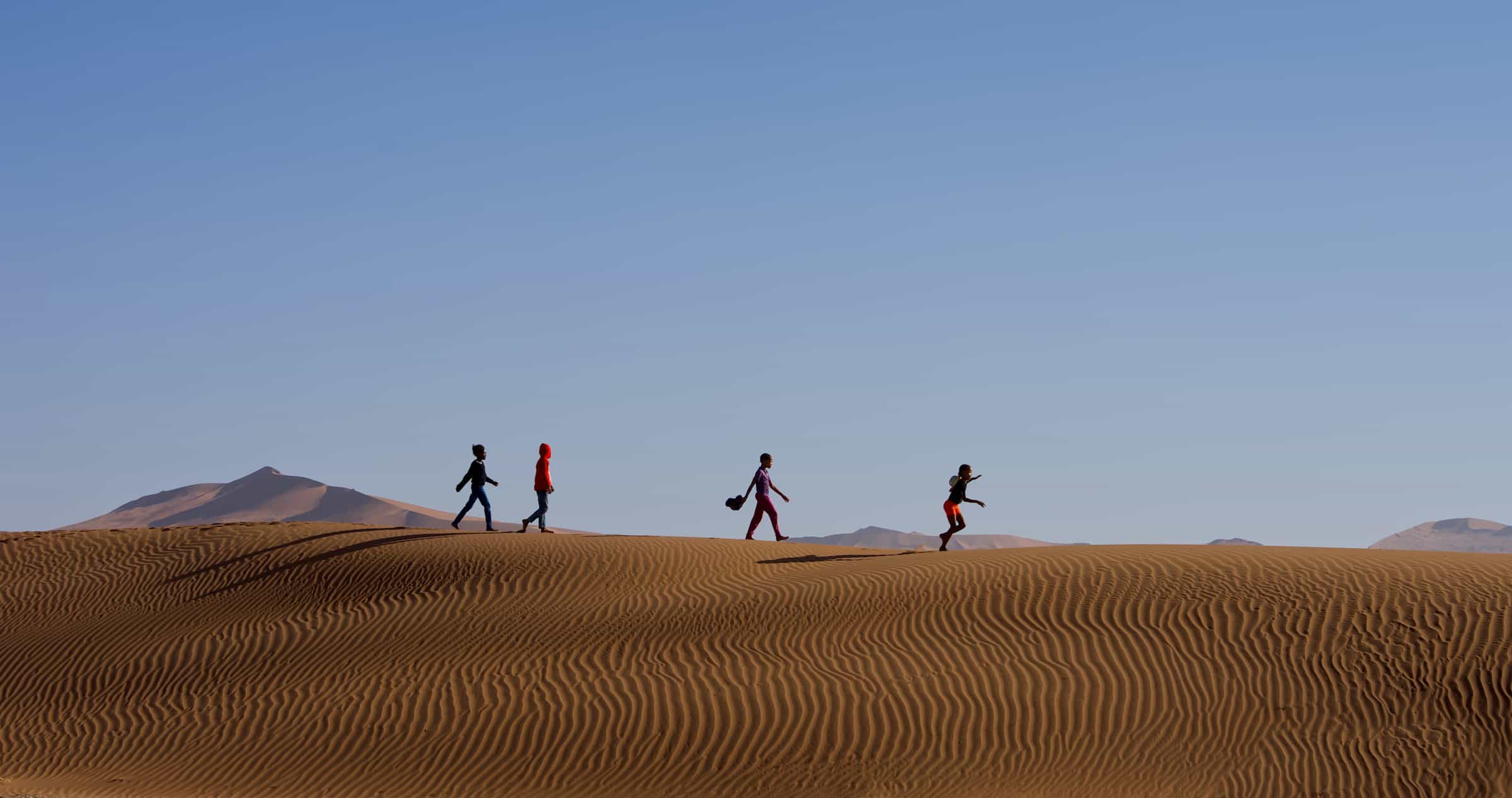
Race by day, reset overnight
Stage Races
A multiday event split into daily stages, with defined starts and finishes plus an overnight camp, hotel, or support base.
Cover photo: Jean Woloszczyk / Unsplash
How the Format Works
Stage races divide a longer route into daily sections. The clock may stop at each finish, but cumulative fatigue, pack weight, weather, food, foot condition, and the quality of overnight recovery carry into the next stage.
The category is broad. Some races are supported, while others require runners to carry food and mandatory equipment. Distance, terrain, timing, accommodation, transfers, and ranking rules must be checked event by event.
Checked figures
One self-supported example
Stage race is not one packing list. The 2026 Marathon des Sables Legendary regulations are a concrete self-supported case. A race that transports a drop bag or serves meals will not match these numbers.
| Measure | Figure |
|---|---|
| MDS Legendary 2026 | About 250 km over six stages in the Moroccan Sahara, with the clock stopping between stages |
| What you carry | Your own food and mandatory kit. The regulations set a pack of 6.5–15 kg, excluding the day's water. |
| Minimum food | 12,000 kcal for the timed stages, at least 2,000 kcal per day. A spot-check shortfall costs a 2-hour penalty. |
| Long stage in the regulations | 65–90 km, partly at night, with a 32-hour limit. The regulations use stage 4 as the example but say the long stage will not necessarily fall there; the road book sets the exact stage and distance. |
| What the organizer provides | Bivouac, water points, route marking, and medical cover. Food is the runner's. |
These figures are the 2026 Legendary regulations, not a template for every stage race. Supported and semi-supported events can ban or supply items this list requires.
Sources: Marathon des Sables Legendary 2026 regulations; Marathon des Sables event page.
Curated preparation path
Learn, Train, and Plan
1. Choose the Right Event
Start with the format range, then compare support, terrain, pack rules, climate, and daily cutoffs.
Types of Multiday Events
Understand stage races alongside timed, backyard, and continuous formats.
GuideChoose Your First Multiday Race
Use support, travel, withdrawal, medical, and terrain questions to compare events.
AnswerBest First Ultramarathon Distance
Why distance alone cannot determine whether a race fits your experience.
2. Prepare for Consecutive Days
Build terrain-specific durability, pack familiarity, and a repeatable recovery routine.
Tapering for Ultramarathons
Reduce fatigue without changing the equipment and movement you have rehearsed.
GuideWalking Strategy for Ultramarathons
Use purposeful hiking and walking to manage terrain and preserve later stages.
GuidePost-Ultramarathon Recovery
Understand recovery signals that also matter between demanding stages.
3. Pack for the Rules
Balance mandatory equipment, pack weight, weather protection, and items you can actually use.
Stage Race Packing List
Separate must-carry equipment from drop-bag, camp, and optional items.
ToolCrew and Drop-Bag Planner
Split must-carry kit from what can wait in a drop bag or at camp.
ToolInteractive Gear Checklist
Build a list that can be reconciled against the organizer's mandatory kit.
4. Fuel and Protect the Week
Test food, fluid, skin, and foot systems under the pack and climate you expect.
Gut Training for Ultrarunners
Practice the foods, textures, and fallback options available during the race.
GuideHydration and Sodium
Adapt to thirst and conditions without treating one fluid target as universal.
GuideBlister Prevention
Address fit, moisture, friction, debris, and hot spots before the next stage.
Curated race directory
Active and Upcoming Stage Race Events
14 matching events as of Oct 20, 2026; event source reviews dated June 22, 2026 – October 20, 2026. 10 past editions remain in the directory archive.
Ultra X South Africa
Western Cape, South Africa
A six-stage, 330 km expedition through the Western Cape's valleys, vineyards, remote gorges, mountain passes, and Cederberg wilderness.
View verified race details →Snowman Race
Laya, Gasa, to Chamkhar, Bumthang, Bhutan
A five-day stage race for selected, invited runners along Bhutan's Snowman Trek, from Laya in Gasa to Chamkhar in Bumthang, covering about 175 km with passes up to 5,470 m to draw attention to climate change.
View verified race details →Himalayan 100 Mile Stage Race
Maneybhanjang, near Darjeeling, India
A five-stage, 100-mile race from Maneybhanjang near Darjeeling up the India–Nepal border ridge to Sandakphu at 11,815 ft, with Everest views and no stage cutoffs.
View verified race details →MDS 120 Jordan
Wadi Rum, Jordan
A three-stage, food-self-sufficient desert race in Jordan’s Wadi Rum, with 70, 100 or 120 km options, three nights at a fixed bivouac and a 3.5 km/h minimum speed.
View verified race details →Ultra X Madeira
Madeira, Portugal
A mountainous two-stage race across Madeira, with a 110 km continuous option and shorter single-day races on the same weekend.
View verified race details →Everest Trail Race
Solukhumbu, Nepal
A six-stage, 170 km Himalayan race in Nepal's Solukhumbu region, reaching 4,104 m with 26,000 m of total ascent and descent.
View verified race details →The Last Desert
Antarctica
The final event in the 4 Deserts Grand Slam. A multi-stage footrace on the Antarctic continent, accessed by expedition ship from Ushuaia, Argentina. The most remote race on the planet.
View verified race details →Ultra X Morocco
Ouarzazate, Morocco
A two-day, 110 km desert ultra around Ouarzazate, with shorter 50 km and 25 km options on rocky trails and oasis terrain.
View verified race details →Beyond the Ultimate Desert Ultra
Namib Desert, Namibia
A 250km self-sufficient desert ultramarathon across five stages in the Namib Desert, with sand dunes, scrubland, heat, and tented camps.
View verified race details →Oman Desert Marathon
Bidiyah, Ash Sharqiyah, Oman
A five-stage, 165 km self-sufficient race across Oman's red, golden, and white dunes, with runners carrying their food and sleeping equipment.
View verified race details →Southern Lakes Ultra
Central Otago to Queenstown, New Zealand
A six-stage journey of roughly 250 km through Central Otago's lakes, mountains, valleys, forests, and gold-mining country to Queenstown.
View verified race details →Ultra ASIA Race
Mai Châu, Vietnam
A four-stage, self-supported 160 km race through the mountains and rice-growing valleys of northwest Vietnam near the Laos border.
View verified race details →Atacama Crossing
San Pedro de Atacama, Chile
A six-stage, 250 km self-supported race through the Atacama Desert's rock canyons, salt flats, and high-altitude valleys.
View verified race details →Ultra X Rwanda
Ruhondo and Musanze, Rwanda
A two-stage, 110 km race through northern Rwanda's volcanic foothills, twin lakes, jungle valleys, and coffee and banana fields.
View verified race details →Dates, entry status, routes, and rules can change. Use each event page's official organizer links before registration or travel. Format preparation paths were reviewed October 2, 2026.
Stage Race FAQs
What is the difference between a stage race and a continuous multiday race?
A stage race has defined daily starts and finishes, usually with an overnight stop. A continuous race keeps the main clock running while runners choose when to rest. Exact timing, penalties, rankings, and support rules still vary.
Do stage-race runners carry all their food and gear?
It depends on the event. Some are self-supported, some transport a camp bag, and others provide extensive food and accommodation. The current organizer rules—not the stage-race label—determine what must be carried.
What should be trained first for a stage race?
Start with consistent endurance and terrain-specific movement you already tolerate. Then add the expected pack, footwear, hiking, descents, food, and recovery routine one variable at a time.
Compare Related Formats
200+ Mile Races
A continuous fixed-distance ultramarathon where route, terrain, sleep, aid access, and a multi-day cutoff shape the race.
Fixed-Distance Multiday Races
A broad family of continuous races where the finish line is fixed but the distance, duration, terrain, and support model vary widely.
6-Day Races
A 144-hour fixed-time event where sustainable routines and recovery choices matter across nearly a full week.