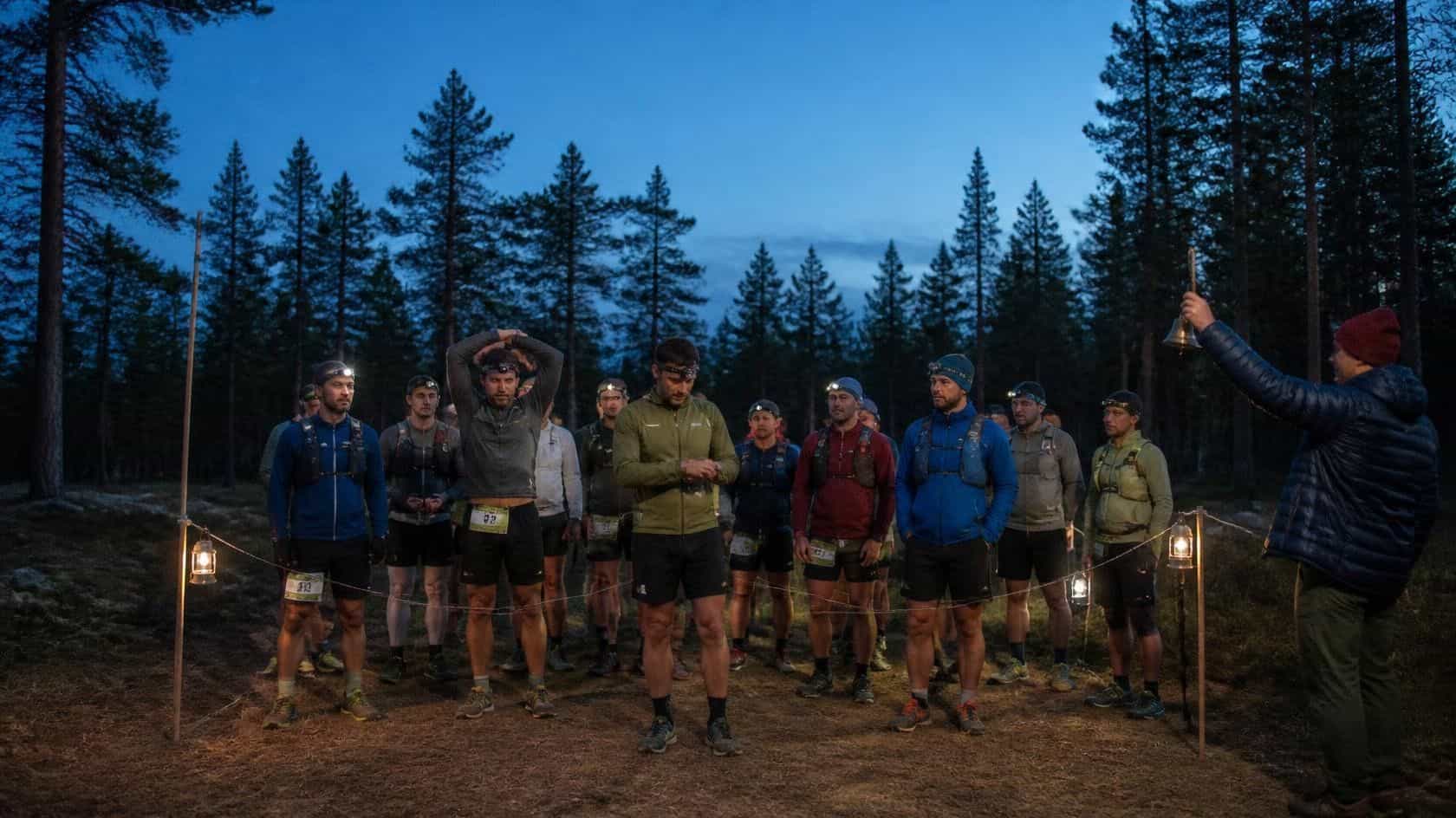
Backyard preparation builds on ordinary endurance training and adds one specific constraint: a new start every hour. Sustainable pace, familiar food, walking, and a reliable routine at base must work together repeatedly. Fitness still matters, including enough pace reserve to finish each yard with time for the tasks you need. The backyard ultra guide collects the rules, strategy, nutrition, and calendar resources around this plan.
16-Week Backyard Ultra Training Plan
This plan is for a runner who already runs about 40 km a week and has finished a marathon or 50K, aiming for 12–24 yards. Repeat a week rather than progressing if you are still sore or tired. If you are still building that base, start with the training timeline and readiness guide.
| Weeks | Weekly volume | Key sessions |
|---|---|---|
| 1–4: Base | 40–50 km | Long run to 2.5 hours; two 20-minute strength sessions a week. |
| 5–8: Introduce the format | 50–60 km | 4-yard mini backyard (26.8 km) in week 6; back-to-back weekend in week 8. |
| 9–12: Rehearse your system | 55–70 km | 8-yard mini backyard (53.6 km) in week 10 with race food and kit; back-to-backs in weeks 9 and 12. |
| 13–14: Final rehearsal | 55–65 km | 6 yards from 16:00 into the dark in week 13, to test lights, layers and crew handovers. |
| 15–16: Taper | About 60%, then 40% of peak | Two short runs at yard pace each week; finalize packing; no fitness tests. |
For a goal of 36 yards or more, peak at 80–100 km a week and make the week-10 simulation 12 yards. On the worksheet, note what you actually completed, how you recovered and what needs to change. A missed week is not a reason to compress the remaining work. The sections below explain the skills to practice within your plan.
A Worked Week and Base Routine
This editorial example assumes a runner already comfortable with about five hours of weekly movement and a 20 km easy run/walk outing on similar terrain. The three-yard practice replaces that outing; it is not added on top. Shorten it to match your established tolerance.
| Day | Session | Practice |
|---|---|---|
| Monday | Rest | Review recovery. |
| Tuesday | 45 minutes easy + 20 minutes familiar strength | Relaxed running and familiar strength work. |
| Wednesday | 45 minutes easy | Practice your tested walk breaks. |
| Thursday | 30 minutes easy + 20 minutes familiar strength | Prepare familiar equipment. |
| Friday | Rest | Lay out the base and agree on a finish time. |
| Saturday | Three yards, starting at 08:00, 09:00, and 10:00 | At 50 minutes per yard, finish at 10:50: 150 moving minutes and 20 minutes between yards. |
| Sunday | 30 minutes comfortable walking or rest | Review feet, energy, and recovery before choosing the next session. |
That is five hours of movement, 40 minutes of strength, and 20 minutes between yards if all sessions are completed. Three standard yards total 12.5 miles (20.1 km). We recommend 50–55 minute yards in the race; practice at 50 so you learn to use the spare minutes.
Where a ten-minute base window actually goes
| Clock | Task |
|---|---|
| 08:50–08:51 | Return to the base area and put down the bottle. |
| 08:51–08:54 | Collect familiar food and refill; record what was actually used. |
| 08:54–08:56 | Check a sock or layer if needed; do not invent work to fill time. |
| 08:56–08:58 | Leave a buffer for an unexpected task. |
| 08:58–09:00 | Return to the corral before the next bell. |
Example review: the second yard took 54 minutes, leaving six minutes instead of ten. Moving the spare bottle beside the food saved a trip to the bag. Next rehearsal: repeat the same number of yards, test that layout, and record whether the smaller window works without rushing. An urgent problem takes priority over another start.
Fill in the existing training worksheet with your own durations, actual loop times, and one change for next time. Use the loop calculator to compare buffers before the rehearsal.
The Training Shift
The hourly deadline changes how you use your fitness. A 55-minute yard averages 7.3 km/h, which is a slow jog with walk breaks; a 50-minute yard averages 8 km/h. Your training goal is to make that pace feel easy for many hours, not to get faster.
- Keep endurance training consistent and within your recovery capacity.
- Practice run/walk transitions that still meet the hourly deadline.
- Make food, clothing, and crew tasks repeatable between starts.
- Evaluate the whole hour, including the walk back to the corral.
Building Your Aerobic Base
The foundation of backyard ultra fitness is a large aerobic base. Most of your training should be at a genuinely easy, conversational pace — the kind of running where you could hold a full conversation without breaking sentences.
The following are planning principles, not entry requirements or a generic prescription:
- Weekly volume: peak at 50–70 km a week for a 12–24 yard goal, or 80–100 km for 36 yards and beyond. Add no more than about 10% a week, with an easier week every fourth week.
- Intensity: keep at least 80% of your running conversational. One short session of marathon-pace running a week is enough speed work for a first backyard.
- Walking as training: practice walking at 6 km/h. Walking about a quarter of each yard and running the rest at about 7.8 km/h (7:40 per km) gives a 55-minute yard.
Simulate the Format
One useful format-specific rehearsal is a format simulation. Run a controlled "mini backyard" with hourly loops:
- Set a loop of approximately 6.7 km (or as close as your local park allows)
- Start a new loop every 60 minutes, on the clock
- Use the rest window between loops to practice your inter-loop routine: eat, drink, change socks, use the toilet, sit briefly
- Test your race-day nutrition, your clothing layers, and your gear setup
A simulation can reveal how quickly rest windows shrink when you need to eat, change, and use the bathroom. You will learn what foods work and what does not. You will understand the rhythm.
We recommend two simulations: 4 yards in week 6 and 8 yards in week 10, both in daylight, plus 6 yards into the evening in week 13. End the session for new pain, illness, unsafe weather or declining coordination.
Finding Your All-Day Pace
Your "all-day pace" is the speed at which you can comfortably complete each loop with enough buffer time for rest, but without accumulating unnecessary fatigue. Our defaults:
- Loop time: 50–55 minutes, leaving 5–10 minutes at base. Under 48 minutes wastes effort; over 56 leaves no margin for a toilet stop or a slow night yard. The race strategy guide covers how the pace changes overnight.
- Effort cue: Conversational effort is usually more useful than a generic heart-rate percentage, especially when heat, fatigue, medication, and sensor error affect the reading.
- Run/walk strategy: walk the same sections every yard from the first one, such as every hill or the first 5 minutes while you eat. Rehearse it in both simulations.
Back-to-Back Long Runs
Back-to-back easy sessions teach you to move on tired legs, which is what yards 10 to 20 feel like. Add them from week 8.
- Structure: 3 hours on Saturday, then 1.5–2 hours on Sunday
- Frequency: every second weekend in weeks 8–12, when there is no simulation
- Purpose: Rehearse pacing, walking, and routine when you do not feel fully fresh—not to deliberately deplete yourself
The Sunday run does not need to be fast. It needs to be consistent. The goal is controlled practice. Persistent pain, worsening fatigue, or poor recovery means the load should be reduced.
Strength and Durability
Repeated loops can expose the same tissues to similar loading for many hours. Strength work may support a broader training plan, but no exercise list prevents injury and load tolerance differs by runner.
A balanced session may include:
- Single-leg control: Examples include split squats, single-leg deadlifts, and step-ups
- Calf capacity: Examples include calf raises; choose the variation and range with a coach or clinician if you have pain
- Hip strength: Examples include bridges, lateral steps, and step-downs
- Trunk control: Examples include planks, dead bugs, and Pallof presses
Do two 20-minute sessions a week until the taper: 2–3 sets of 8–12 repetitions, stopping two repetitions short of failure. Reduce the work if it leaves your legs heavy for the next run.
Night Logistics Without Sleep Deprivation
A race may extend into darkness, but deliberately depriving yourself of sleep is not required preparation. Sleep loss impairs endurance and cognition, and a training session cannot safely reproduce every race effect.
Rehearse the controllable logistics instead:
- Do a short dusk or early-evening session on a familiar, low-risk route with a partner or support person. Finish before excessive sleepiness and arrange transport so you never drive drowsy.
- Practice headlamp running to dial in your equipment and adapt to altered depth perception.
- Rehearse clothing changes, spare-light access, crew communication, and the between-loop checklist without extending the session through your normal sleep period.
- Test caffeine in the evening simulation at the race-night dose of about 50 mg per yard from the backyard nutrition guide, and note stomach, heart rate and that night's sleep.
Protecting Pre-Race Sleep
In a small 2024 backyard-ultra study, better self-reported sleep during the week before the event was associated with smaller changes in some reaction-time measures. The study included 11 men in its final analysis, so it supports protecting sleep but does not establish a universal sleep-banking protocol.
Practical options:
- Protect opportunity: aim for at least 8 hours in bed each night of race week, at your usual times.
- Track gently: A simple journal can identify patterns. Consumer wearables estimate sleep and should not be treated as a diagnosis or a score you must perfect.
- Nap only if you already do: a 20-minute nap is fine; race week is not the time to start a new routine.
Extra sleep opportunity cannot guarantee protection from race-day sleep deprivation. Persistent insomnia, loud snoring with breathing pauses, or excessive daytime sleepiness warrants discussion with a qualified clinician rather than a self-designed protocol.
Mental Preparation
The open-ended format differs from a fixed-distance race and may benefit from specific mental tools:
- Micro-goal segmentation: Do not think about the whole race. Think only about the current loop. Then the next one. Break the event into individual hours, not total distance.
- Boredom preparation: A 24-hour ultramarathon study found an association between reported action crises and boredom; it did not prove that boredom universally causes withdrawal. Test safe, event-permitted options such as conversation, music, or micro-goals.
- Pre-committed safety checks: Write down red flags and who will call race medical staff. Never pre-commit to continuing through confusion, hallucinations, involuntary sleep, poor coordination, chest pain, or another medical warning sign.
- Personal motivation: Identify why the event matters to you—meaning, challenge, self-fulfillment, or community—without treating motivation as a reason to ignore safety.
- Visualize the hard parts: Do not just visualize success. Visualize the moment at 3 AM when your feet hurt, your stomach is revolting, and the next loop feels impossible. Then visualize yourself pausing, completing the safety check, and either starting safely or stopping without shame.
Sources
- Big's Backyard Ultra — Official backyard ultra directory and championship information
- Walsh, N.P. et al. (2021) — Sleep and the athlete: expert consensus recommendations. British Journal of Sports Medicine.
- Benchetrit, S. et al. (2024) — Sleep deprivation, extreme exertion, and cognitive performance at a backyard ultra. PLOS ONE.
- Lopes, T.R. et al. (2023) — How much does sleep deprivation impair endurance performance? A systematic review and meta-analysis. European Journal of Sport Science, 23(7), 1279–1292.
- Guest, N.S. et al. (2021) — ISSN position stand: caffeine and exercise performance. Journal of the International Society of Sports Nutrition.
- Weich, C. et al. (2022) — Does boredom matter for ultra-endurance athletes' crises? International Journal of Environmental Research and Public Health.
Frequently Asked Questions
How do you train for a backyard ultra?
Build over 16 weeks to 50–70 km a week for a 12–24 yard goal, mostly at conversational effort. Every second weekend, run a back-to-back (3 hours, then 1.5–2 hours). Run a 4-yard mini backyard in week 6 and an 8-yard one in week 10, and add two 20-minute strength sessions a week.
What is a mini backyard simulation?
A training session with a new 6.7 km loop started every hour on the clock, used to rehearse pacing, food, clothing and the routine between yards. We recommend 4 yards (26.8 km) in week 6 and 8 yards (53.6 km) in week 10, both in daylight.
How important is pre-race sleep?
Very. In a small 2024 backyard study, better sleep in the week before went with smaller drops in reaction time during the race. Aim for at least 8 hours in bed each night of race week, and do not start the race already short.
How many weeks should you train for a backyard ultra?
Sixteen weeks if you already run 40 km a week and have finished a marathon or 50K. Add 8–12 weeks of base building first if you have not. For a 36-yard-plus goal, peak at 80–100 km a week.